In this glossary we will address issues related to heat transfer
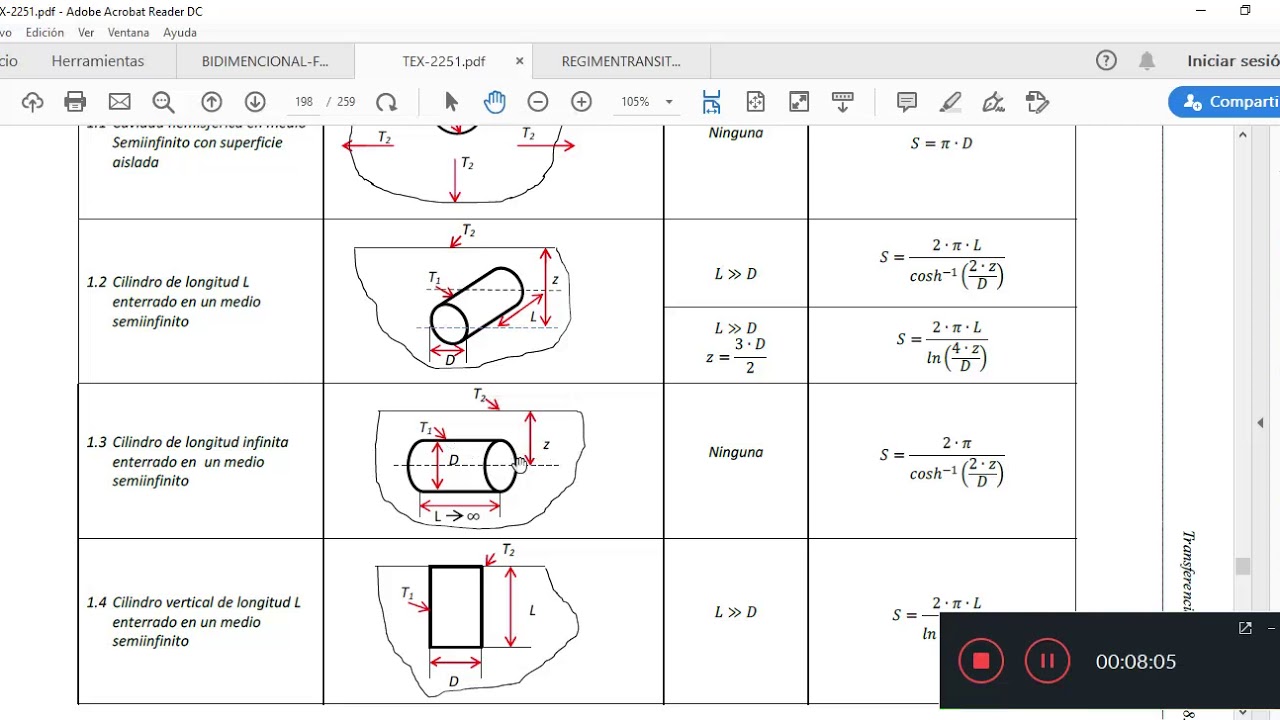
Conduction shape factor.
verb.
Where s it is form factor conduction, which has the dimension of length, and k is the thermal conductivity of the medium between the surfaces. The driving form factor only depends on the geometric configuration of the system.
Example: Once the shape factor value for a specific geometric configuration is known, the total steady-state heat transfer rate can be determined from the equation.
es: Factor de forma de conducción.
Convection resistance
Verb
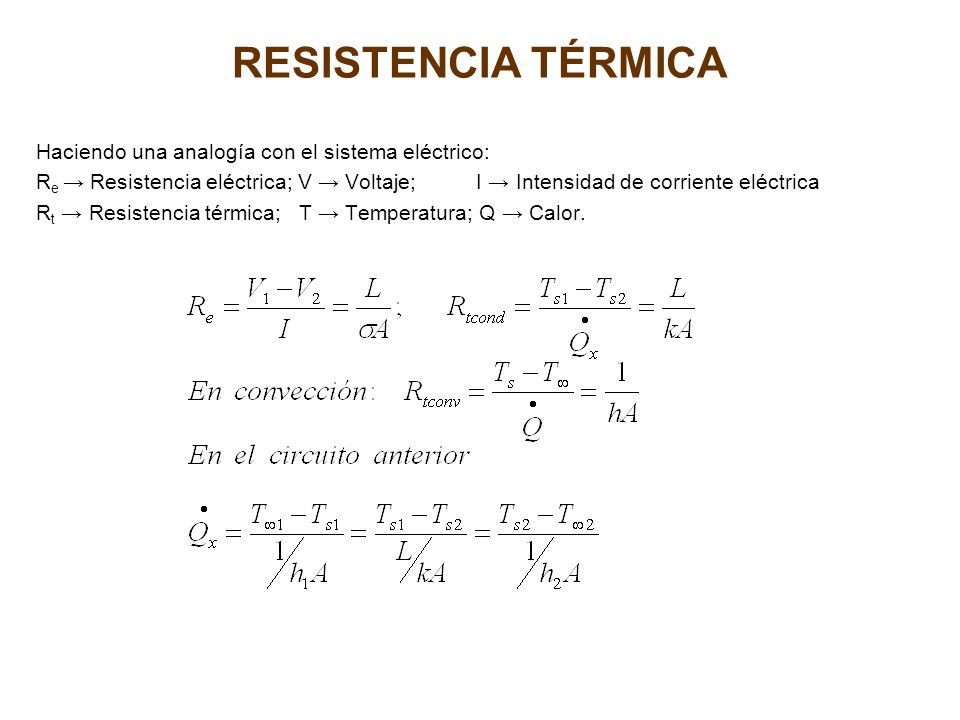
Convection resistance can be defined as the inverse of the convection heat transfer coefficient per unit area, since it is defined as Rconv = 1hA
Example: Consider a surface of area A in which the convection and radiation heat transfer coefficients are hconv and hrad.
es: Resistencia a la convección
Critical radius of insulation.
Verb.
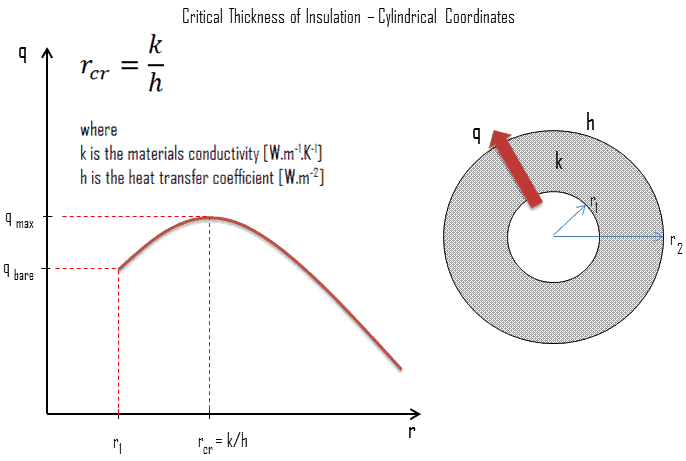
It can be deduced that the critical insulation radius depends on the thermal conductivity of the insulation k and the external convection heat transfer coefficient h.
Example: This trend continues until the outer radius of the insulation corresponds to the critical radius, where the heat rate reaches its maximum.
es: Radio crítico de aislamiento.
Cylinder conduction resistance
Verb
In this case, the network of thermal resistances consists of a resistance to conduction and two to convection, in series, precisely like that for the flat wall
Example: Total resistance for a cylinder case, Now consider the one-dimensional steady-state flow of heat through a cylindrical or spherical layer that is exposed to convection on both sides into fluids that are at temperatures T∞1 and T∞2,
es: Resistencia de conducción del cilindro
Efficiency.
Verb.
The thermal performance or efficiency of a thermal machine is a dimensionless coefficient or ratio calculated as the quotient of the energy produced and the energy supplied to the machine.
Example: The thermal efficiency, ηth, of any heat engine is defined as the ratio of work to heat input.
es: Eficiencia.
Fin effectiveness.
Verb.
is the relationship between the thermal power (Q-point) that is dissipated in it and the thermal power that is dissipated without a fin from the area of the base that it occupies on the primary surface.
Example: Heat transfer between metal and air is less efficient than from liquid to metal, so fins are used.
es: Eficacia de la aleta.
Fin efficiency.
Verb.
The efficiency of a fin is the relationship that exists between the heat (Qf) that is transferred from a fin under certain conditions, and the maximum heat transfer (Qmax) that would exist if that fin were at the maximum temperature (the temperature of the base).
Example: The fins are used when the coefficient of heat transfer by convection h is little.
es: Eficiencia de las aletas.
Interface resistance.
Verb
to increase the performance of heat transfer between silicon chip and copper heat sink.
Example: The grade work presents the results obtained for the shear strength parameters at the soil-concrete interface.
es: Resistencia de interfaz.
Plane wall conduction resistance
Verb
It is the resistance that the material opposes to the passage of heat transfer
Example: Heat conduction in a large flat wall. Consider the flat wall of thickness 2L, in which there is a uniform and constant heat generation per unit volume.
es: Resistencia a la conducción de la pared plana
Radiation resistance
Verb.
Radiation resistance is the act of manufacturing electronic components and systems that are resistant to damage or malfunction caused by ionizing radiation.
Example: Radiation resistant components are based on their non-resistant equivalents, to which variations in design and manufacturing are made to reduce this susceptibility to damage.
es: Resistencia a la radiación.
Sphere conduction resistance
Verb
In addition to the flat wall problem, there are two other basic one-dimensional steady-state problems that we consider: These problems are the case of a hollow cylinder so long that the losses at the ends are negligible, or that its ends are isolated to avoid loss and, furthermore, the case of a hollow sphere.
Example: Now consider the one-dimensional steady-state flow of heat through a cylindrical or spherical layer that is exposed to convection on both sides.
es: Resistencia a la conducción de la esfera
Surfaces.
Verb.
A surface can be considered as the infinitely thin film that separates two regions of space.
Example: If a surface encloses a finite region of space we speak of a body. Thus, for example, a conical surface limited by its vertex and a base plane gives rise to a cone.
es: Superficies.
Thermal contact conductance
Verb
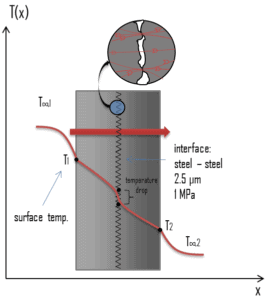
It is a property that indicates the thermal conductivity, or ability to conduct heat, between two bodies in contact. The inverse of this property is called thermal contact resistance.
Example: thermal contact conductance is the study of heat conduction between solid bodies in thermal contact.
es: Conductancia de contacto térmico
Thermal contact resistance.
Verb.
K] or the thermal contact resistance [m 2. K / W] represents the heat conduction between two solid bodies.
Example: Contact resistance is highly dependent on surface roughness.
es: Resistencia al contacto térmico.
Total thermal resistance
Verb
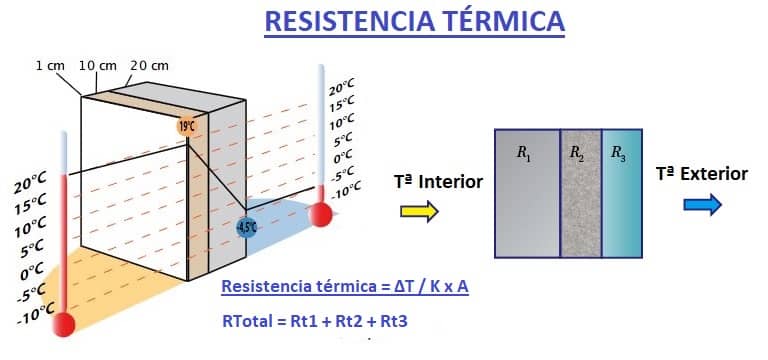
When the element described is in a real situation, with ambient air on its two faces, the total thermal resistance Rt is defined as the sum of the thermal resistance of the constructive element plus the surface thermal resistances; is the inverse of the transmittance (U), or heat transfer coefficient of an element (K).
The thermal resistance of a material represents the ability of the material to oppose the flow of temperature.
Example: The thermal resistance of an element made up of several layers, each of them made of homogeneous material, is equal to the sum of the resistances of each of the layers.